01. Overview
In January, I attended Tallinn Winter School's Experimental Interaction Design course, a two-week program focused on design methodologies and hands-on prototyping using Arduino or Raspberry Pi. Working in teams of 3-4, we developed a health wearable project, applying our learnings to real-world solutions.
Bringing together diverse expertise, our team of four, a Product Designer (me), a Business Analyst, a Mechanical Engineer, and a Sociology major, worked to design a meaningful health wearable.
02. Problem
"Prolonged sitting and poor posture cause chronic pain, muscle weakness, and long-term health risks. Even regular exercise isn't enough—proper sitting habits and movement are crucial for overall well-being."
Studies from Verywell Health reveal that people aged 28 to 49 sit for an average of 8.5 hours daily, and even those who meet the recommended exercise guidelines still experience higher BMI and elevated cholesterol levels. Another study indicates that simply standing instead of sitting doesn’t necessarily lower heart disease risk and may even contribute to varicose veins or orthostatic hypotension. Research by Diaz suggests that taking a five-minute walk every 30 minutes can help regulate blood sugar and blood pressure.
Poor sitting habits can also lead to Dead Butt Syndrome as addressed by
Dr. Robert Trasolini on People, where a weak
gluteus medius from prolonged sitting or slouching causes nerve issues over time.
He advises,
“Set an alarm every 30 minutes, get up stretch every hour, take a short walk for between three
and five minutes. Those allow the muscle to respond and get this thing stronger.”
The BetterHealth Channel advises improving posture by crossing legs at the ankles instead of the knees to prevent muscle weakness and leg bulkiness from prolonged static sitting.
Addressing these issues requires a conscious effort to improve posture, move regularly, and adopt healthier sitting habits.
03. Research
Studies at The University of Melbourne and PubMed Central indicate, that healthy individuals typically adjust their sitting posture between 10 to 30 times per hour, which helps alleviate discomfort in areas such as the neck, shoulders, and back.
However, many people encounter two primary challenges:
Forgetting to change posture
regularly: Prolonged static sitting can lead to increased discomfort and potential
health
issues.
Uncertainty about correct sitting posture: Lack of awareness regarding proper
ergonomics can
result in musculoskeletal stress and related disorders.
We had a clear idea of what we wanted to create, but we needed more clarity on how the industry and academic research were addressing this problem. To gain insights, we began by conducting a competitive analysis of various existing products available online.
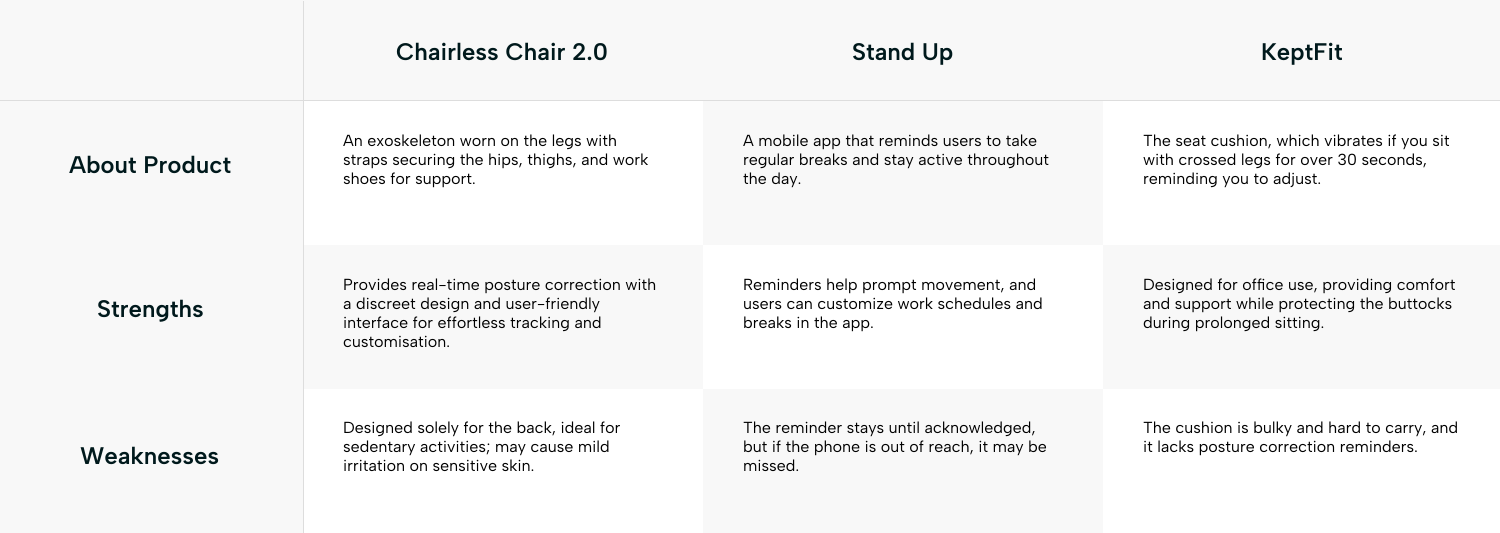
Insights from our competitive study reveal key weaknesses in existing solutions:
Vibrating cushions help with posture changes but are often bulky, non-portable,
and only work
for sitting. They also lack position detection and user calibration.
Reminder apps prompt users to take breaks, but they require manual scheduling
and constant phone
dependence for notifications.
These limitations highlight the need for a more adaptive, portable, and intuitive solution that
seamlessly integrates posture correction with movement reminders.
04. Persona, Solution & Storyboard Scripts
We created personas based on our target age group and user segment, focusing on individuals who commonly experience posture-related issues. These personas help us understand user pain points, behaviors, and needs, ensuring our product effectively addresses their concerns and provides meaningful benefits.
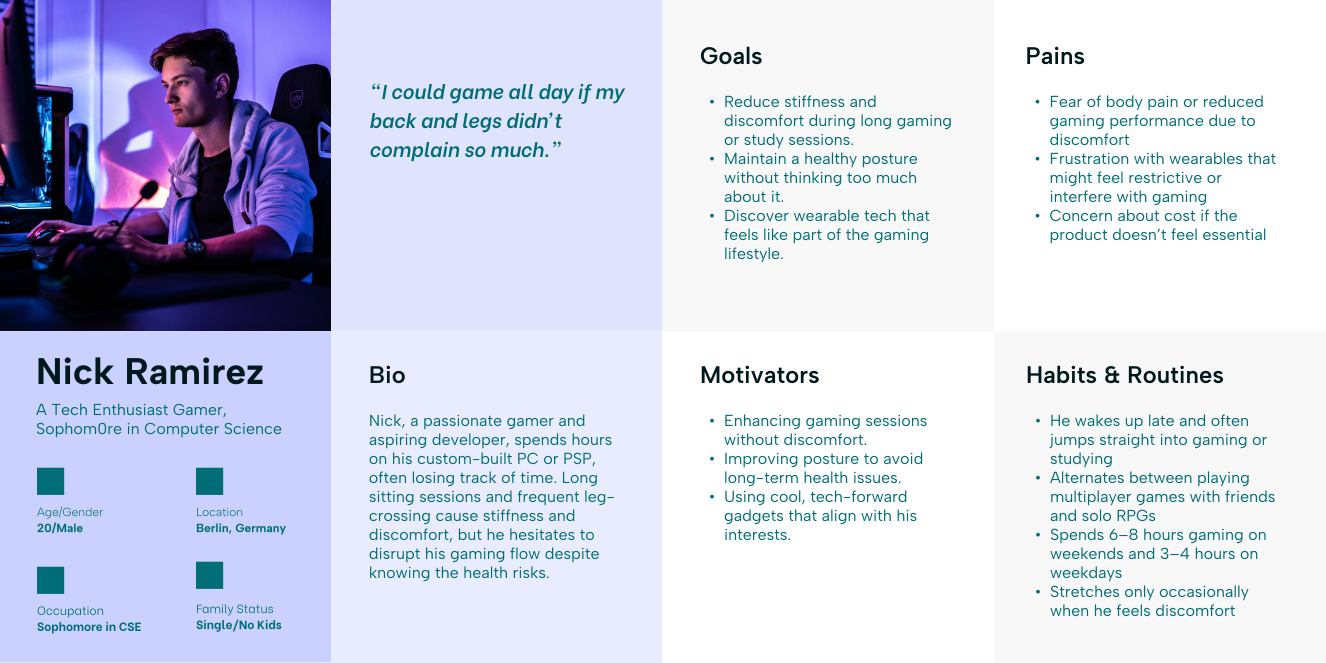
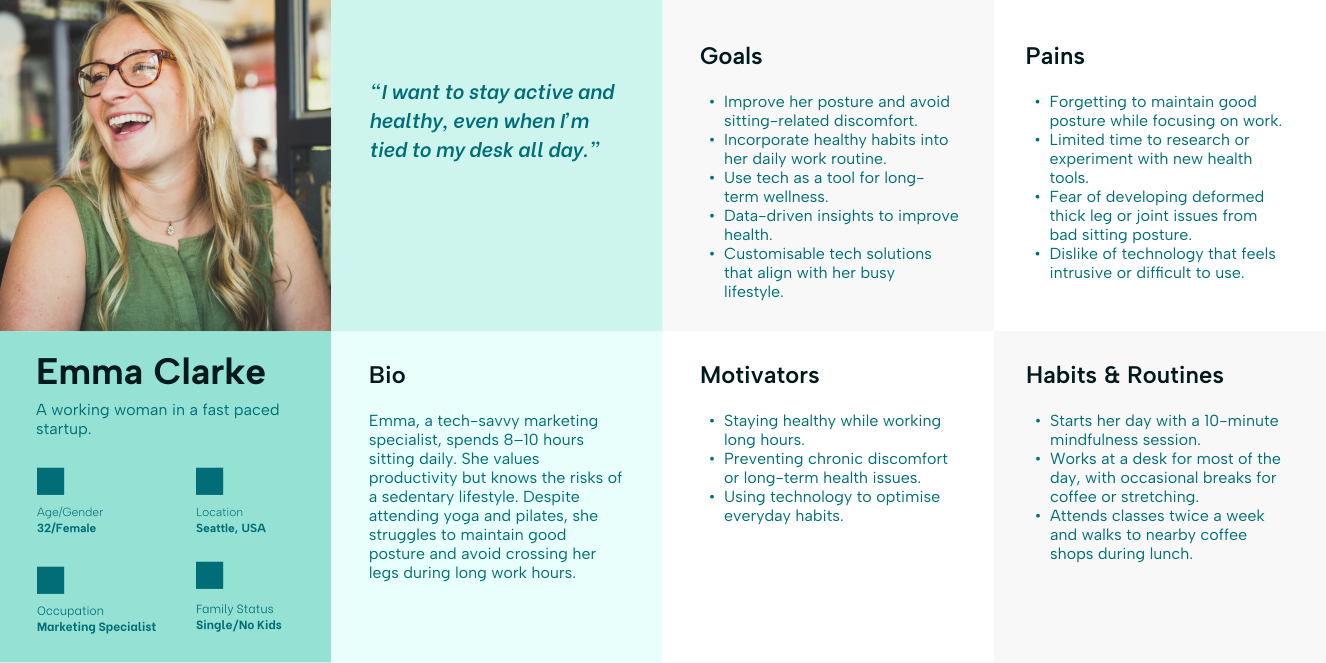
"We developed CoolSit, a wearable solution consisting of a waist belt and knee band, designed to promote better sitting habits and regular movement."
These two independent devices work together to calibrate the user's posture within the first 5-10 seconds of sitting, ensuring personalized tracking.
CoolSit continuously monitors posture every 2 minutes. If the user remains in the same position for over 5 minutes, the actuators gently vibrate, prompting a posture change. This encourages micro-movements, preventing stiffness and discomfort.
To further combat prolonged inactivity, CoolSit delivers gentle nudges every 30 minutes, reminding users to stretch, walk, or engage in light movement. This ensures a balance between comfort and activity, reducing the risks associated with sedentary behavior.
Next, we brought our personas to life by developing scenarios and storyboards that illustrate how they would interact with our product in real-world situations. This helped us visualize user journeys, challenges, and key touchpoints, ensuring our solution seamlessly integrates into their daily lives. By mapping out these scenarios, we identified how our product adds value, improves posture habits, and enhances overall well-being for our target users.
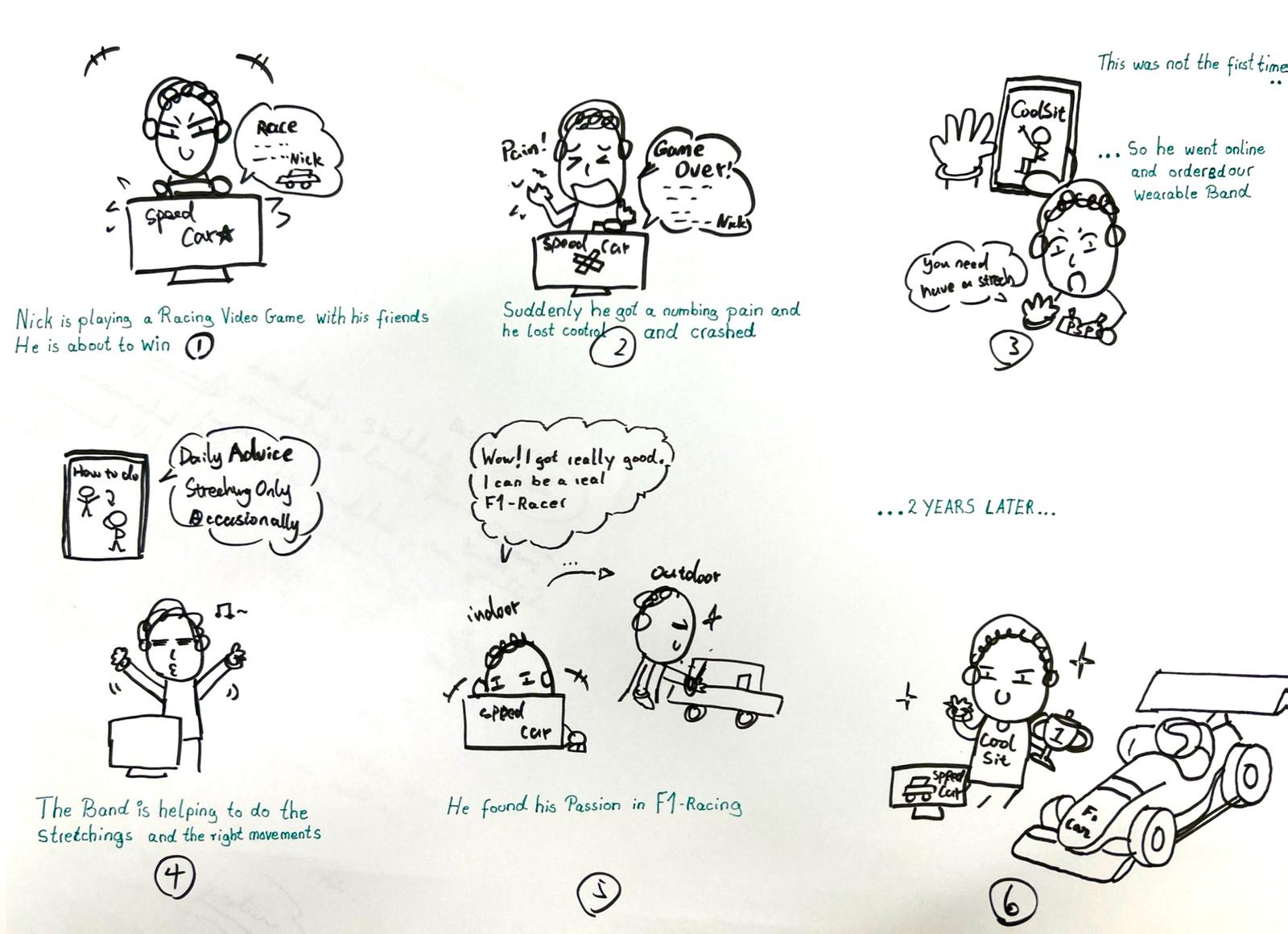
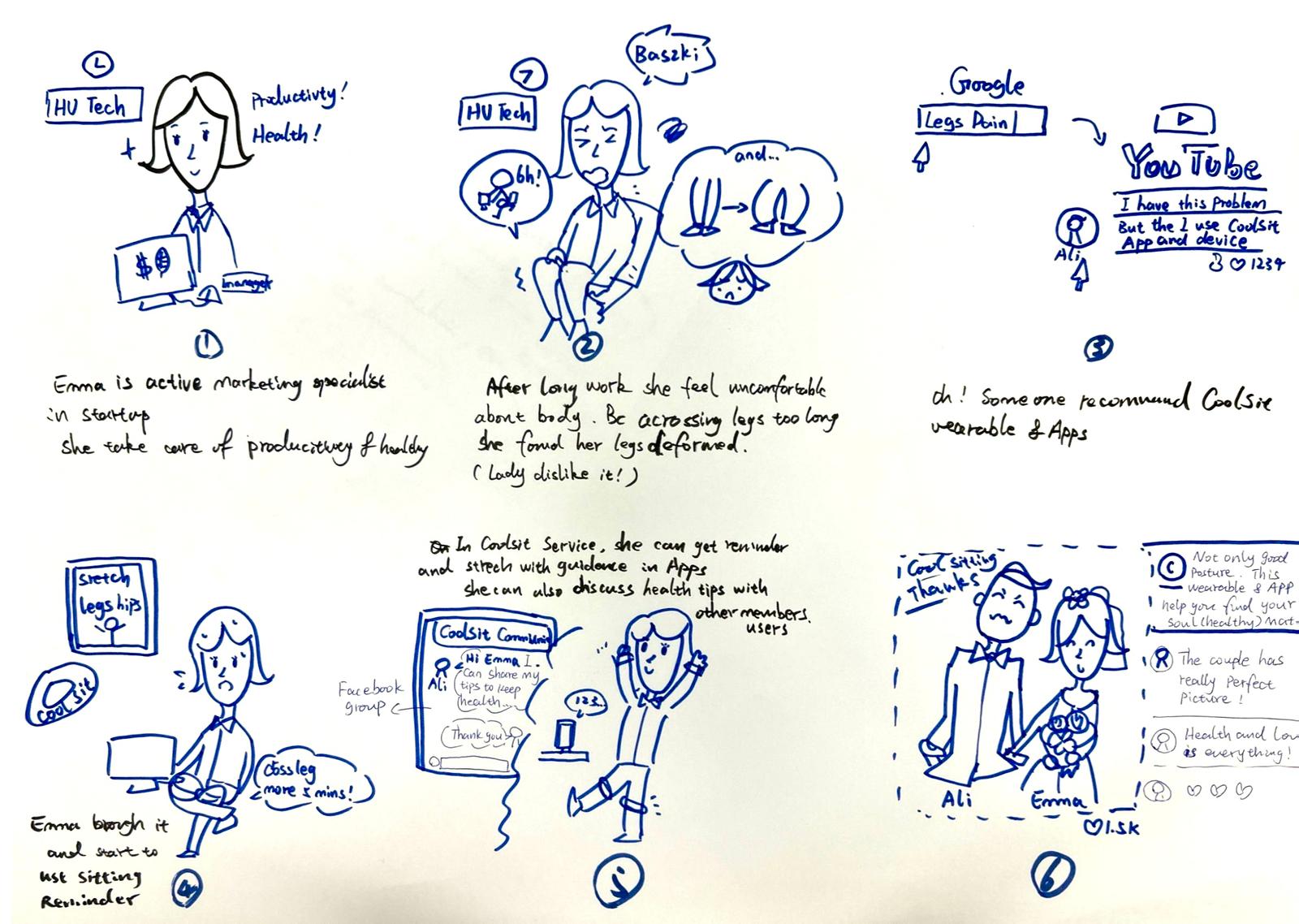
Huge shoutout to Siyu for the incredible illustrations that brought our vision to life! 🎨.
05. Hardware Requirements & Lo-Fi Prototype
Now, it’s time to bring our idea to life by diving into the hardware implementation!
To build our waist belt and knee band, we need:
2 Arduino Uno boards to allow both devices to function independently.
3 vibration motors (actuators), two for the waist belt and one for the knee
band, providing haptic feedback.
2 gyroscope sensors to accurately detect and monitor body posture and
movement.
Jumper wires and a power unit to ensure seamless connectivity and reliable performance.
With these components, we’re ready to prototype and refine our posture-correcting wearable!
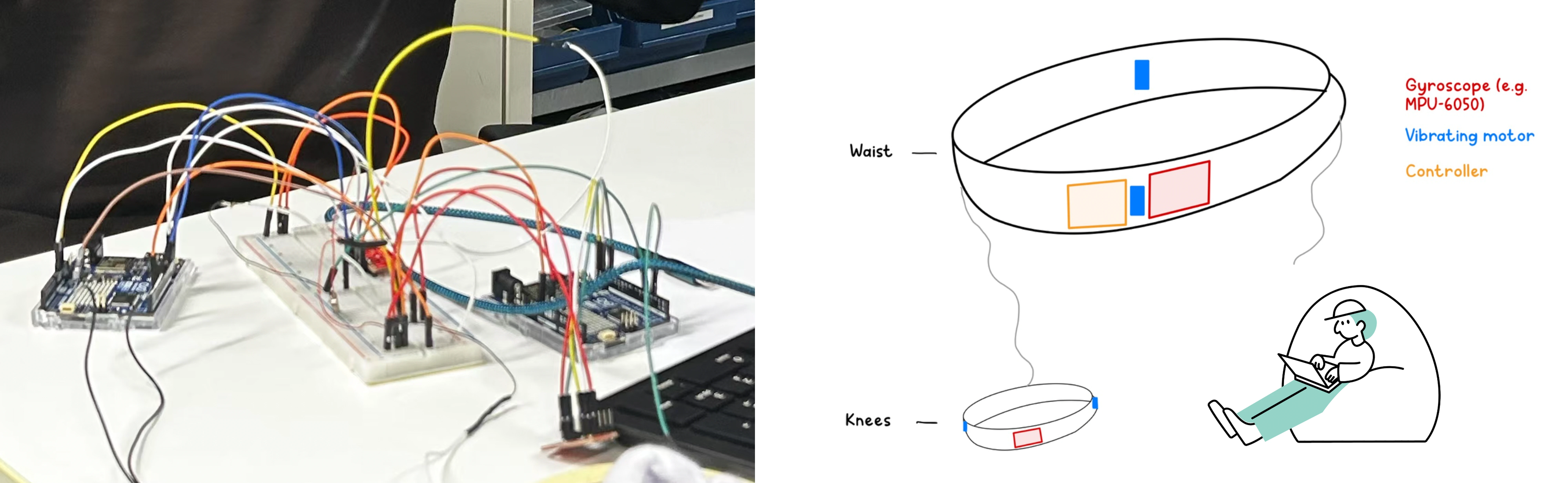
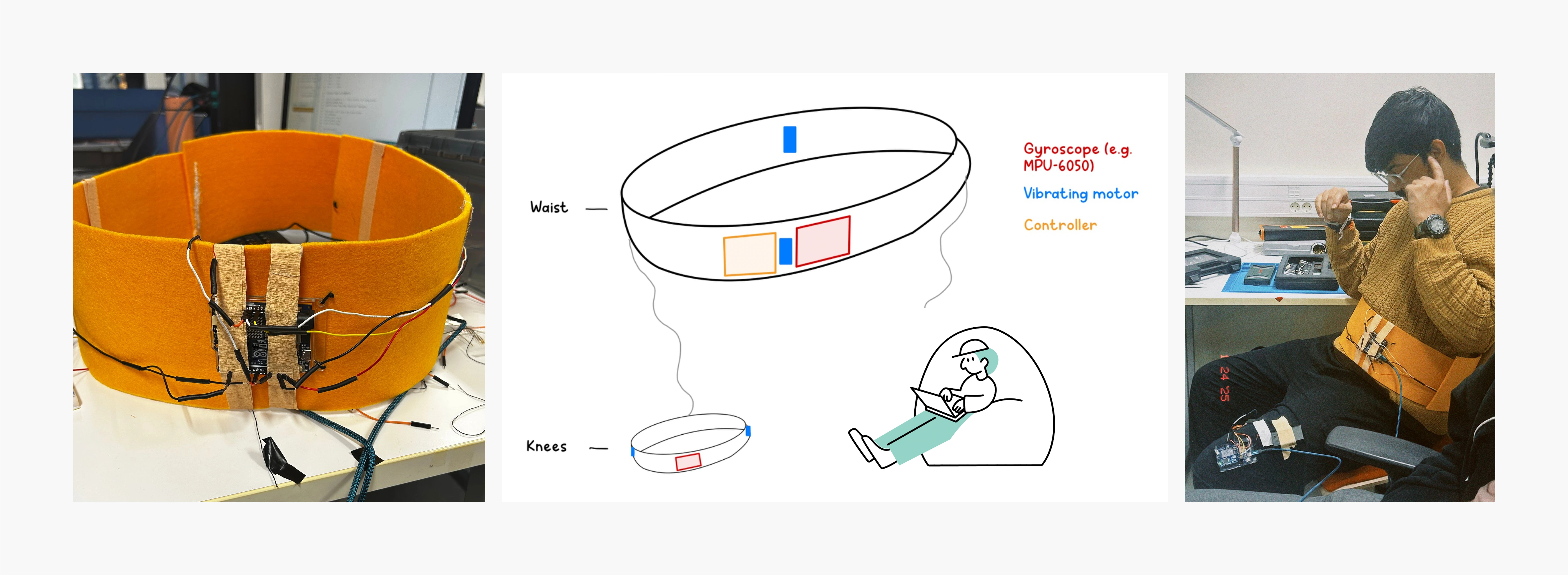
Left: A lo-fi prototype showcasing Arduino connections.
Right: A concept visualization of how the prototype will look in real life.
Coding the Arduino was easy, but fine-tuning it for real use took effort.
Nils and I worked to ensure it detects posture changes accurately while
allowing natural movement. We tweaked the sensors to avoid false alerts,
making reminders effective yet non-intrusive.
📌 Check out the Arduino code here.
Our system ensures real-time posture correction by tracking movement and angles through
precise sensors:
Knees: If no movement is detected for 5 minutes (test phase: 10
seconds), the device sends a gentle vibration reminder to encourage repositioning.
Waist Tilt Angle: When the user exceeds the optimal sitting
posture, the system triggers a reminder to readjust posture for better spinal alignment.
Roll & Pitch Angles:
Roll: Monitored between -5° to 5°, ensuring minimal sideways tilting.
Pitch: Maintained within -10° to 10°, preventing excessive forward
or backward leaning.
By continuously tracking these parameters, our device helps users develop healthy
sitting habits and reduce the risk of posture-related discomfort.
3 vibration motors (actuators), two for the waist belt and one for the knee band, providing haptic feedback.
2 gyroscope sensors to accurately detect and monitor body posture and movement.
Jumper wires and a power unit to ensure seamless connectivity and reliable performance.
Right: A concept visualization of how the prototype will look in real life.
Knees: If no movement is detected for 5 minutes (test phase: 10
seconds), the device sends a gentle vibration reminder to encourage repositioning.
Waist Tilt Angle: When the user exceeds the optimal sitting
posture, the system triggers a reminder to readjust posture for better spinal alignment.
Roll & Pitch Angles:
Roll: Monitored between -5° to 5°, ensuring minimal sideways tilting.
Pitch: Maintained within -10° to 10°, preventing excessive forward
or backward leaning.
By continuously tracking these parameters, our device helps users develop healthy sitting habits and reduce the risk of posture-related discomfort.
06. Hi-Fi Prototype and Designs
To shrink the prototype and eliminate loose connections, we had to get resourceful. Since no existing band or belt met our hardware needs, we handcrafted one by sewing three pieces of fiber cloth together and adding Velcro for a secure fit. For the knee band, we luckily found a suitable fabric tucked away in the lab.
To ensure stable, permanent connections, we soldered every wire and sensor, making the prototype more reliable and durable. Adaptability and hands-on creativity turned our challenges into solutions!
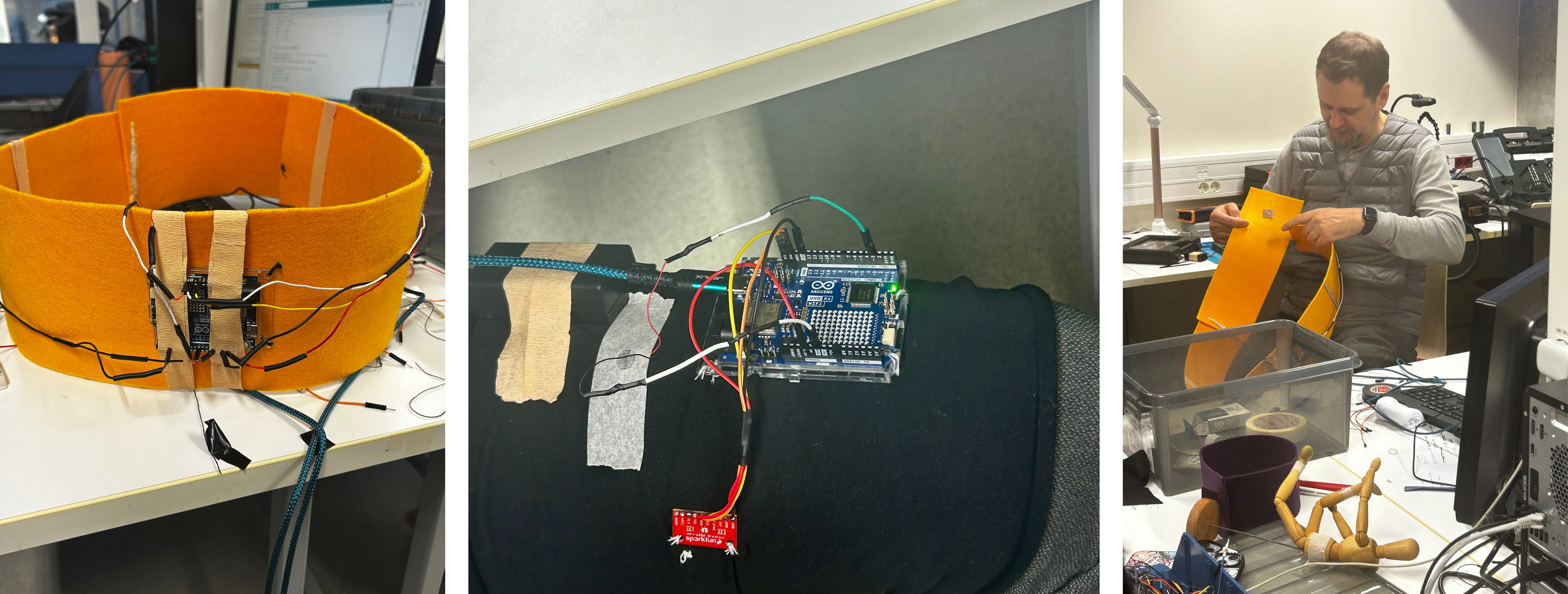
Left: Hi-Fi prototype of the Waist Belt.
Middle: Hi-Fi prototype of the Knee Band.
Right: Our instructor, Vladimir Tomberg, testing the prototype for final
evaluation.
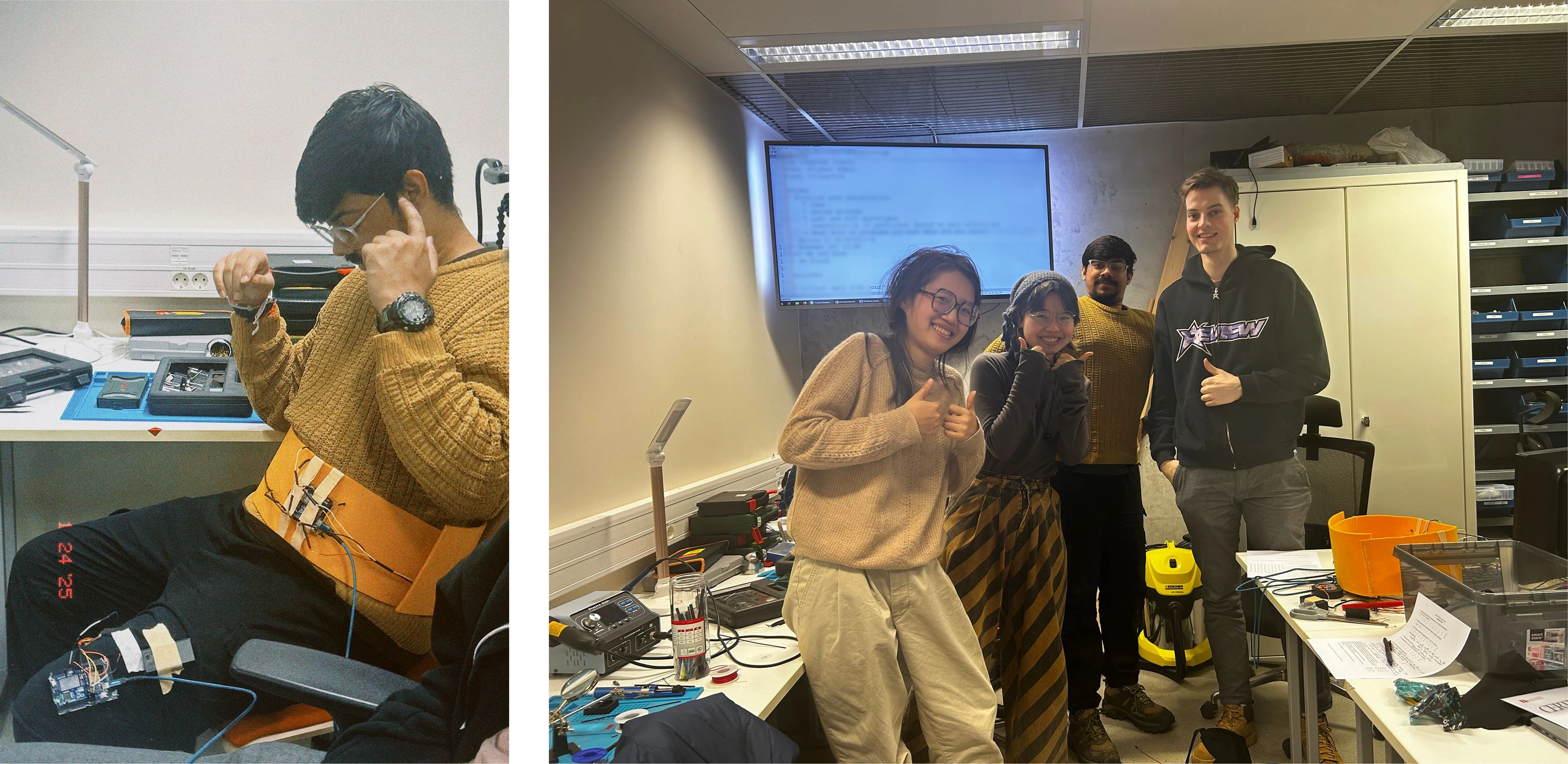
Left: That's me, testing and making sure everything works
perfectly!
Right: My amazing team! From left to right – Lan Li, Siyu, Me (Arnab), and Nils
Bodemer 🚀🎉
07. Key Takeaways & Future Possibilities
1. Building and implementing everything in just two weeks was an incredible experience! I learned so much, not just about design and prototyping, but also unexpected skills like sewing and soldering.
2. Working in a diverse team made a huge difference. Collaborating with individuals from different backgrounds gave us unique perspectives on solving problems, making our solution more well rounded and effective.
3. Future Improvements: We could explore adding an arm band to address numbness from prolonged device use. Holding a controller or mobile phone for long periods can restrict blood flow, leading to discomfort, something our wearable could help prevent!
4. Assistive App Integration: Enhancing the smart belt and posture control knee band with an assistive app to provide quick stretching exercises and movement support for improved mobility and posture correction.
Discover case studies